

How many of these essential highlights do you know?
The Tower as a prison
The Tower was the most important state prison by the Tudor age.
The first recorded prisoner held in the Tower of London was Ranulf Flambard, Bishop of Durham. He was also the first prisoner to escape the Tower.
Many Tower prisoners carved graffiti into the walls of their cells. Carvings can still be seen in the Beauchamp and Salt Towers today.
Sir Thomas More was imprisoned at the Tower for refusing to recognise Henry VIII as head of the English church. He was probably held in the lower part of the Bell Tower.
Thomas Cromwell became Master of the Jewels at the Tower in 1532. After his dramatic fall from power, Cromwell was imprisoned at the Tower before his execution in 1540.
Sir Walter Raleigh was a prisoner of Elizabeth I in 1592 - and then James I & VI between 1603-1616. Raleigh was also held at the Tower before his execution in 1618.
In 1605, Guy Fawkes was imprisoned and interrogated at the Tower following the discovery of the Gunpowder Plot.
In 1554 Princess Elizabeth was detained at the Tower by her half-sister Mary I. Elizabeth returned to the Tower as Queen for her coronation procession in 1559.
Jacobite Simon Fraser, 11th Lord Lovat, was held at the Tower before his execution on Tower Hill in 1747. His death was the last public beheading in Britain.
The Kray Twins were among the last prisoners locked up inside the Tower of London. The twins were imprisoned for dodging National Service in 1952.
Murder and mystery
At least 150 people have been executed in and around the Tower over the centuries.
Very few people were actually executed inside the Tower of London. Instead, most condemned prisoners were executed on Tower Hill.
In 1471 Henry VI died in mysterious circumstances as a prisoner in the Tower of London. According to tradition, he was assassinated whilst at prayer in the Wakefield Tower.
The ‘Bloody Tower’ is named for its popular association with the disappearance of the ‘Princes in the Tower’ in 1483. Their fate remains a mystery to this day.
Anne Askew was the only woman known to have been tortured at the Tower. Charged with heresy, interrogators put Anne on the rack to force her to reveal the names of those who shared her beliefs.

Image: The Bell Tower where Sir Thomas More was probably imprisoned. © Historic Royal Palaces.

Image: Traitors' Gate where many prisoners entered the Tower of London from the Thames. © Historic Royal Palaces.

Image: The White Tower. A fortress built for William the Conqueror. © Historic Royal Palaces.
The Tower as a fortress
The White Tower was built for William the Conqueror after the Norman Conquest of 1066. It was built between 1078-1100.
The Tower was built as a defensive fortress and its walls were only breached once, during the Peasants’ Revolt in 1381.
The Tower dramatically expanded during the 13th century. Henry III and his son Edward I strengthened the fortress’s defences and built the magnificent Medieval Palace.
The Royal Mint – where all the country’s coins were made – was at the Tower from around 1279 during the reign of Edward I until 1810-12, when it transferred to another site on Tower Hill.
Sir Isaac Newton was made Warden of the Mint at the Tower of London in 1696.
The White Tower’s four domed roofs (or cupolas) were added by Henry VIII in preparation for Anne Boleyn’s coronation in 1533.
The northeast circular turret of the White Tower is known as the ‘Flamsteed Turret’. It was named for Astronomer Royal John Flamsteed, who used it as an observatory in 1675.
The Crown Jewels
After the execution of Charles I in 1649, Parliament ordered the Crown Jewels to be brought to the Tower of London and destroyed.
New Crown Jewels were made for the Coronation of Charles II in 1661. They have been on display at the Tower ever since.
In 1671 Colonel Thomas Blood tried to steal the Crown Jewels. He was miraculously pardoned for his crime.
In 30 October 1841 a devastating fire destroyed the Tower’s Grand Storehouse. The Waterloo Barracks now sits on that site, the current home of the Crown Jewels.
In 1913, Suffragette Leonora Cohen threw an iron bar at a display case in the Jewel House. A note attached to the bar read ‘Votes for Women. 100 Years of Constitutional Petition, Resolutions, Meetings & Processions have Failed’.

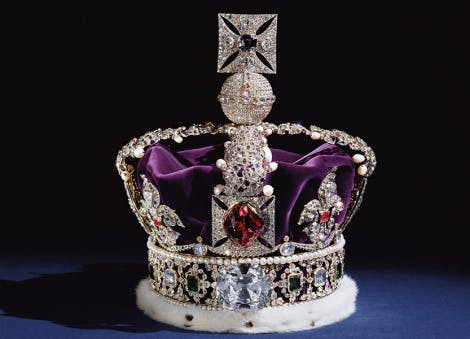
Image: St Edward's Crown, made for the coronation of King Charles II in 1661. © Royal Collection Enterprises Limited 2026 | Royal Collection Trust

Image: Yeoman Warders at the Beating the Bounds ceremony in 2026. © Historic Royal Palaces.
The Tower as a palace
The Yeoman Warders were originally the monarch’s personal bodyguard and have been at the Tower since the reign of Henry VIII.
Elizabeth of York, Queen Consort to Henry VII and mother of Henry VIII, died at the Tower of London on 11 February 1503.
Royal trumpeter and Black Tudor musician John Blanke took part in Henry VIII’s coronation procession from the Tower of London to Westminster in 1509.
Three queens of England have been laid to rest in the Chapel of St Peter Ad Vincula – Anne Boleyn, Catherine Howard and Lady Jane Grey.
Charles II was the last monarch to stay at the Tower before their coronation, a tradition dating back to the reign of Richard II.
In 1843 the Tower moat smelt so bad that the Duke of Wellington (appointed Constable of the Tower in 1826) had the water drained. This created the defensive dry ditch seen today.
Animals at the Tower
The Tower was home to a collection of animals, including lions, tigers, an elephant and a polar bear, known as the Royal Menagerie from the 1200s to 1835.
The Menagerie brought about the oldest recorded April Fool’s joke. First reported in 1686, visitors were sent to the menagerie to watch the fictitious ‘Annual Ceremony of Washing the Lions’.
One of the earliest known Tower of London guidebooks was published in 1741. Written for children, it lists the animals kept inside the Tower’s menagerie.

Image: A barrage balloon in the West Moat during the Second World War. © Historic Royal Palaces.
During the World Wars
Eleven spies were executed at the Tower of London by firing squad during the First World War.
In 1940 the Yeoman Warders planted allotments in the south moat. This provided fresh vegetables for the Tower community during the Second World War.
Josef Jakobs was the last person to be executed inside the Tower of London. He was shot for espionage in the Tower’s miniature rifle range on 15 August 1941.
During the Second World War the RAF tethered a barrage balloon in the Tower of London’s moat to help defend the city against the Blitz.
The North Bastion was built in 1848 to strengthen the Tower’s defences. It was destroyed by the Blitz on 5 October 1940, killing Yeoman Warder Samuel Reeves and resident Lily Frances Lunn.
The Tower of London was hit several times during the Blitz. Repairs to the extensive bomb damage remain visible around the fortress today.

Image: Two of the resident Tower ravens. © Historic Royal Palaces.
Post-war times until today
In 1953 a stunning 14th century wall painting was discovered in the Byward Tower. Among the colourful figures is St Michael - the ‘Byward Angel’.
In 2014, 888,246 ceramic poppies flooded the Tower moat. Known was ‘Blood Swept Lands and Seas of Red’, the installation marked 100 years since the start of the First World War.
In 2022, Over 20 million seeds from 29 flower species were planted in the Tower of London moat for Superbloom to celebrate Queen Elizabeth II’s platinum Jubilee.
The Ceremony of the Keys – where the Chief Yeoman Warder locks the gates to the Tower– takes place at the fortress every night.
The ravens are a famous part of the Tower. By tradition, it is said if the ravens leave the Tower then the fortress and the kingdom will fall
The Tower of London has its own private pub, known as the ‘Yeoman Warders Club’ or ‘The Keys’.
Soldiers have always been stationed at the Tower. Today, Five Regiments of Foot Guards from the Household Division perform ceremonial duties around the fortress. Duties are also performed by other UK and Commonwealth regiments.
Gun salutes take place on the Tower’s Wharf to mark ceremonial occasions. This includes state visits, the Monarch’s birthday and coronation day.

Image: A gun salute for the Emperor and Empress of Japan in 2024. © Historic Royal Palaces.
Browse more history and stories

9 surprising facts about the Tower of London Moat
The Tower of London Moat wasn’t always the dry ditch that it is today. Did you know it was once filled with fish? Or that it has been used as an allotment? Here are 9 surprising facts about the moat at the Tower of London.
The Crown Jewels
The history of the Crown Jewels, including the Imperial State Crown - a priceless collection used to crown the kings and queens of England.

The royal household in the medieval period
What was it like to live and work in the Medieval Palace?